
Here’s the straight-up rundown of current OSHA and ANSI requirements for first aid supplies in U.S. workplaces:
📌 1. OSHA Requirements (Legal Requirement)
Regulation:
- OSHA’s general industry standard 29 CFR 1910.151(b) says you must have adequate first aid supplies readily available if you don’t have a clinic, hospital, or infirmary nearby. It also requires a person trained to render first aid if you’re outside that “near proximity.” “Adequate” isn’t spelled out in detail — that’s where ANSI comes in.
What OSHA actually enforces:
- First aid supplies must be accessible quickly (not locked away with no access).
- Supplies must be appropriate for the workplace hazards — not just band-aids for a heavy machine shop.
- If there is a reasonable expectation of exposure to blood or infectious materials, you must provide appropriate PPE (gloves, shields, etc.).
- Construction work sites are covered under 29 CFR 1926.50 with the same general directive.
Important nuance: OSHA doesn’t list a mandatory inventory. It requires access to adequate supplies and trained responders, but leaves specifics open.
📌 2. ANSI/ISEA Z308.1 Standards (Consensus Standard — Not a Regulation)
OSHA points employers to the ANSI/ISEA standard as the best way to meet its vague requirement for “adequate first aid supplies.”
Current Version
- ANSI/ISEA Z308.1-2021 is the latest American National Standard for workplace first aid kits and supplies.
What It Does
ANSI sets minimum contents, classification of kits, and general guidance on how many and where they should be. It’s industry best practice — OSHA often treats compliance with this standard as de facto compliance with the OSHA requirement.
Kit Types & What They Mean
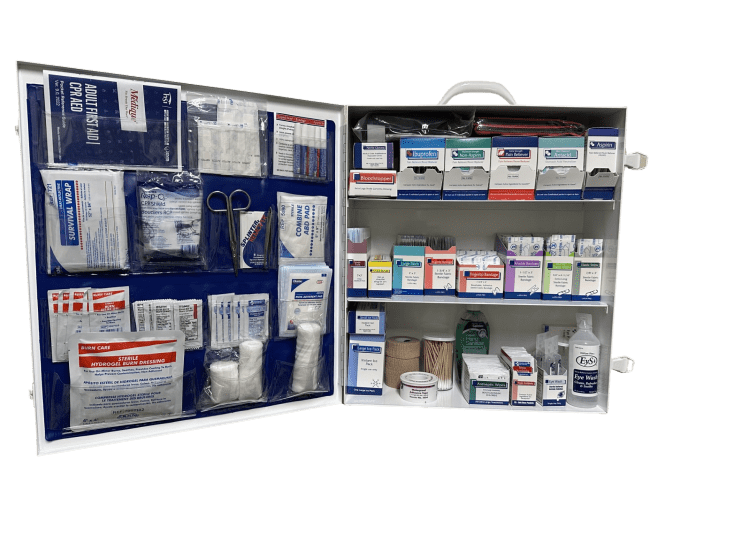
- Class A Kits: Basic supplies for most common workplace injuries (cuts, abrasions, burns, eye injuries, etc.). Common for low-hazard environments.
- Class B Kits: Broader supply list for more complex or higher-risk workplaces (construction, industrial sites, etc.). Includes more dressings, gloves, and often a tourniquet.
Minimum Contents (Representative Example)
Here are some items ANSI requires for compliance — this is not OSHA law, but if you ignore ANSI, you make it harder to prove OSHA compliance:
Class A (examples):
- Adhesive bandages
- Antiseptic/antibiotic applications
- Burn treatments and burn dressings
- Cold pack
- CPR breathing barrier
- Eye/skin wash
- First aid guide
- Foil blanket
- Medical exam gloves
- Roller bandages
- Scissors
- Trauma pads
- Triangular bandage
(Quantities are specified in the standard.)
Class B adds (examples):
- More bandages
- Larger quantities of antiseptics and treatments
- Splints and tourniquets (for more serious trauma)
(Actual ANSI lists specify exact counts.)
📌 3. Key Practical Points
- OSHA doesn’t list a precise inventory — it simply says first aid supplies must be there and ready.
- The ANSI standard is your de facto minimum. If OSHA shows up and you have ANSI-compliant kits matched to hazards, you’re in a strong compliance position.
- You must assess hazards and adjust your kit contents — band-aids aren’t enough for welding burns or chemical exposures.
- First aid supplies must be accessible without unreasonable delay — locked closets that only one guy can open aren’t acceptable when someone’s bleeding.
- Regular inspection and restocking is expected: expired items replaced, used items replenished. ANSI covers this guidance; OSHA expects you to maintain adequacy.
📌 4. Training Requirements
- OSHA requires personnel trained to administer first aid when medical services aren’t nearby. That means at least one trained person per shift in many workplaces.
Here’s the clear, no-nonsense ANSI Z308.1-2021 minimum checklist for workplace first aid kits — the consensus standard OSHA defers to when it comes to what should actually be in your kit. These aren’t OSHA laws by themselves, but if your kits meet them they’ll satisfy OSHA’s requirement for adequate supplies tailored to workplace hazards.
📋 ANSI Z308.1-2021 Required Minimum Contents (Class A vs Class B)
🔹 Class A (Basic Workplace Kit)
Intended for general workplaces with common injury risks (small businesses, offices, retail). Minimum required contents:
| Item | Minimum Quantity |
|---|---|
| Adhesive Bandages (1″ x 3″) | 16 |
| Adhesive Tape (2.5 yd total) | 1 |
| Antibiotic Application packets | 10 |
| Antiseptic packets | 10 |
| Burn Dressing (gel soaked, 4″ x 4″) | 1 |
| Burn Treatment packets | 10 |
| Cold Pack (4″ x 5″) | 1 |
| CPR Breathing Barrier | 1 |
| Eye Coverings w/attachment | 2 |
| Eye/Skin Wash (total 1 fl oz) | 1 |
| First Aid Guide | 1 |
| Foil Blanket (52″ x 84″) | 1 |
| Hand Sanitizer packets | 10 |
| Medical Exam Gloves | 4 |
| Roller Bandage (2″ x 4 yd) | 1 |
| Scissors | 1 |
| Sterile Pads (3″ x 3″) | 2 |
| Trauma Pads (5″ x 9″) | 2 |
| Triangular Bandage (40″ x 40″ x 56″) | 1 |
(Minimal kit for typical cuts, abrasions, minor burns, eye/skin irrigation.)
🔹 Class B (Enhanced Workplace Kit)
For higher-risk, complex, or larger workplaces (construction, warehouses, plants). Includes everything from Class A in greater quantities plus critical trauma items.
| Item | Minimum Quantity |
|---|---|
| Adhesive Bandages (1″ x 3″) | 50 |
| Adhesive Tape (2.5 yd total) | 2 |
| Antibiotic Application packets | 25 |
| Antiseptic packets | 50 |
| Burn Dressings (gel soaked, 4″ x 4″) | 2 |
| Burn Treatment packets | 25 |
| Cold Pack (4″ x 5″) | 2 |
| CPR Breathing Barrier | 1 |
| Eye Coverings w/attachment | 2 |
| Eye/Skin Wash (total 4 fl oz) | 1 |
| First Aid Guide | 1 |
| Foil Blanket (52″ x 84″) | 1 |
| Hand Sanitizer packets | 20 |
| Medical Exam Gloves | 8 |
| Roller Bandage (2″ x 4 yd) | 2 |
| Roller Bandage (4″ x 4 yd) | 1 |
| Scissors | 1 |
| Splint (4″ x 24″) | 1 |
| Sterile Pads (3″ x 3″) | 4 |
| Trauma Pads (5″ x 9″) | 4 |
| Tourniquet | 1 |
| Triangular Bandage (40″ x 40″ x 56″) | 2 |
(Class B expands coverage for trauma, immobilization, and more serious injuries.)
🔍 How to Use These Checklists in the Real World
- OSHA doesn’t regulate “exact item lists”; it expects you to have appropriate supplies readily available. ANSI provides the industry-accepted minimum inventory that satisfies OSHA’s 1910.151(b) adequacy requirement.
- Choose Class A for low-hazard environments; go Class B for higher risk work (heavy equipment, construction, manufacturing).
- Kits must be clearly labeled, accessible without delay, and inspected regularly (stock levels, expiration, usability).
- ANSI also specifies container types (I, II, III) based on where and how they’re stored or transported.
🧠 Bottom Line
You don’t have to memorize this list — buy ANSI Z308.1-2021 labeled Class A or Class B kits from reputable safety suppliers. But if you’re assembling your own, use this checklist as the baseline. OSHA expects adequate supplies matched to your hazards and ANSI Z308.1 is the practical definition of “adequate.”
Frequently Asked Questions
Q: What first aid kit labeling and markings are required?
A: Section 7 of ANSI/ISEA Z308.1-2021 addresses labeling and marking of first aid kits. Each kit must be labeled with its contents and their locations must be visibly marked. All labeling and markings must be legible, permanent and if adhesive labels are used they must not be easily removed.
Q: Is bloodborne pathogen-related personal protective equipment required in first aid kits?
A: No, but OSHA does recommend it in 29 CFR 1910.151 Non-Mandatory Appendix A: “If it is reasonably anticipated that employees will be exposed to blood or other potentially infectious materials while using first aid supplies, employers are required to provide appropriate personal protective equipment (PPE) in compliance with the provisions of the occupational exposure to bloodborne pathogens standard, 1910.1030(d)(3). This standard lists the appropriate PPE for the type of exposure, such as gloves, gowns, face shields, mask or eye protection.”
Sources
OSHA January 2007 Letter of Interpretation
The Hartford Consensus IV: A Call for Increased National Resilience
The information contained in this article is intended for general information purposes only and is based on information available as of the initial date of publication. No representation is made that the information or references are complete or remain current. This article is not a substitute for review of current applicable government regulations, industry standards, or other standards specific to your business and/or activities and should not be construed as legal advice or opinion. Readers with specific questions should refer to the applicable standards or consult with an attorney.
 Serving the Fargo-Moorhead region since 1987